
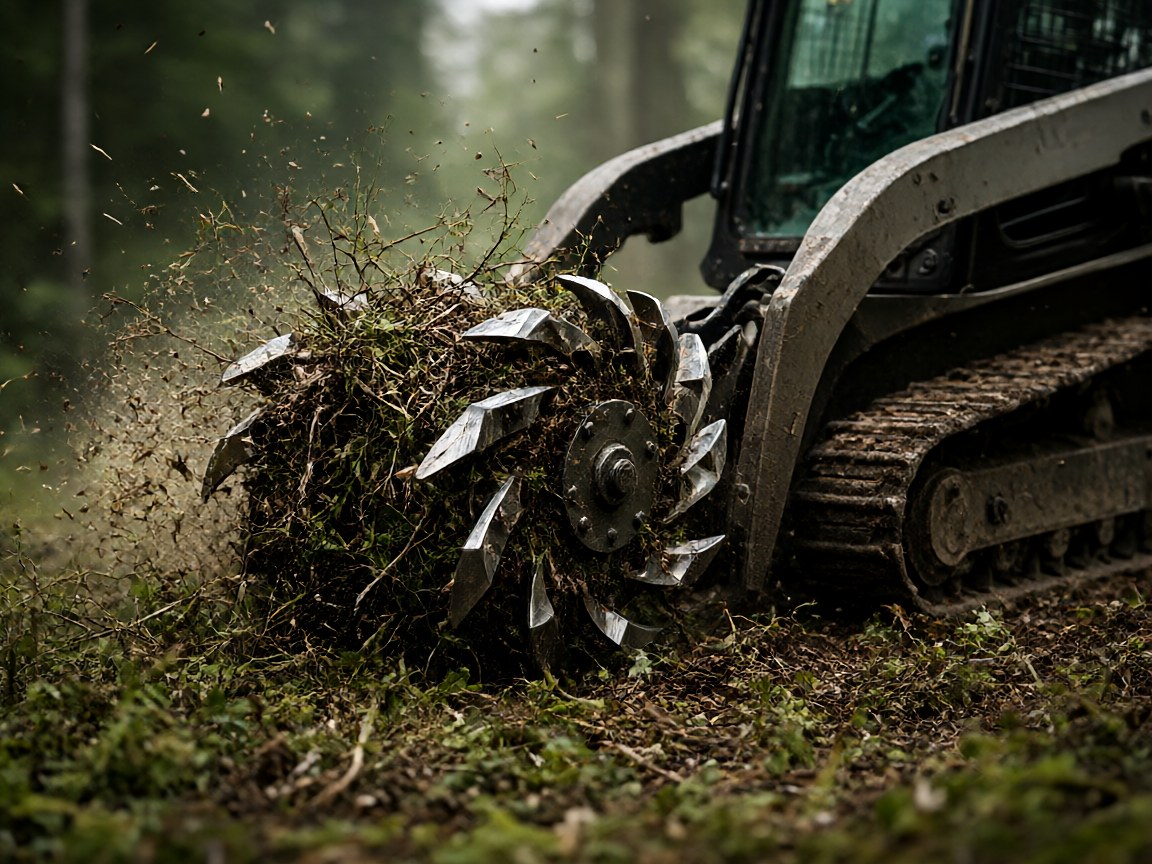
A right-of-way crew in the Southeast put a Battle Ax Light head on a compact track loader and burned through a set of beaver teeth in roughly 60 hours. Sandy soil, small hardwood, and a rotor turning at full speed the whole day. The teeth were not defective — they were simply the wrong style for abrasive ground, and the two carbide hammers that should have been on that rotor would have lasted three times longer. The dealer had the right tooth on backorder for two weeks.
Loftness mulcher teeth are a small family of parts that covers a large spread of heads, and the most expensive mistake is mixing them up. This guide sets out which rotor family takes which tooth, how to identify the tooth you are holding by thread and dimensions, and how the BauRong replacements map to the Loftness heads in the field. For the wider picture on tooth classes and carbide grades, see our forestry mulcher teeth guide.
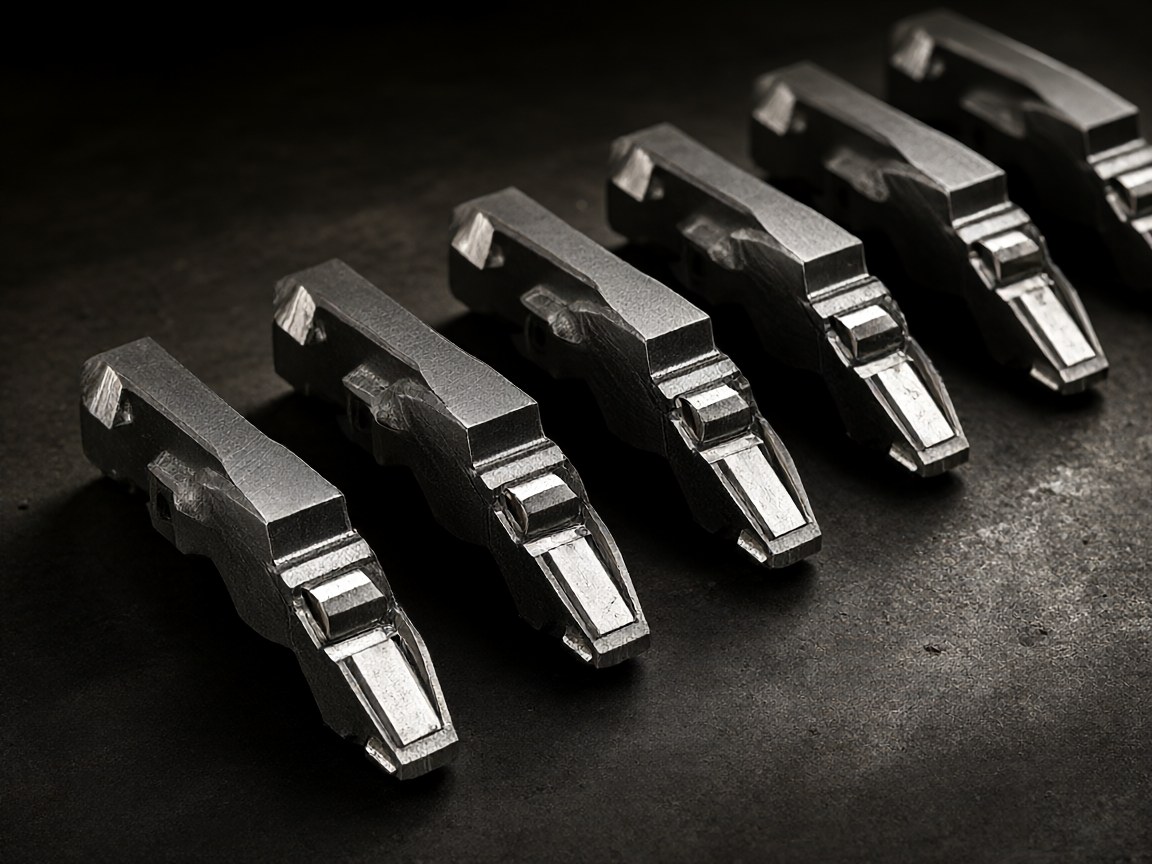
The Loftness rotor families and the tooth each one takes
Loftness builds mulching heads for skid steers, compact track loaders and excavators. Three families show up most often in aftermarket demand, plus the carbide cutter line:
- Battle Ax — the heavy forestry head. Runs double carbide hammer teeth for abrasive conditions, and Quadco-style reversible planer knives where a cleaner cut matters.
- Battle Ax Light — the lighter rotor for smaller carriers. Narrower hammer teeth, typically around 1.8 inch (45 mm) wide with a 3/4 inch thread.
- Tree Shredder — the brush and right-of-way head. Takes Quadco-style planer knives; a carbide hammer will not seat in a planer knife position.
- Carbide Cutter G4 — the rock-capable rotor. Takes a heavy single-tip carbide tooth with additional body protection, not a planer knife.
The practical rule: a planer knife and a carbide hammer are not interchangeable, even inside the same family. Decide by rotor first, then by ground condition — green wood and clean brush favour a knife, rock and sand favour carbide.
How to identify the Loftness tooth you have
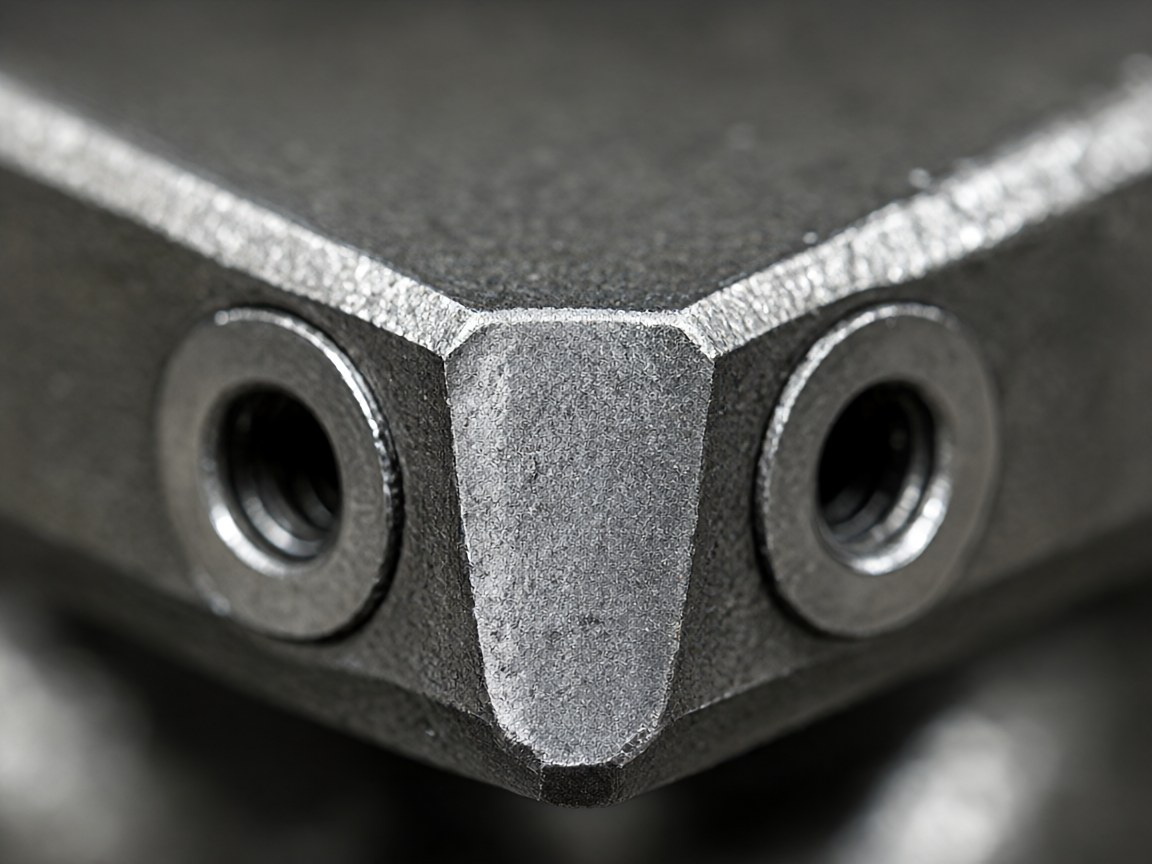
Part numbers get cross-referenced, superseded and copied across the aftermarket, so the reliable identification is mechanical. Measure and record five things:
- Thread. 3/4-16 UNF on the Quadco-style beaver teeth and planer knives; M16 fine thread on the heavy carbide cutter teeth.
- Shank or no shank. Some rotors take a tooth with a locating shank, some take a flat-base tooth. They are not interchangeable.
- Width at the cutting face. The Battle Ax Light hammer measures roughly 1.8 inch (45 mm); the Battle Ax hammer is wider.
- Body dimensions and weight. These are the numbers that settle it: a BR-FM2028 is 81.2 × 40 × 40 mm at 0.6 kg, a BR-FM2005 is 61.2 × 38 × 27.3 mm at 0.5 kg.
- Carbide layout. One large tip with body protection is a rock tooth; two tips is a dual carbide hammer; a straight reversible edge is a planer knife.
Original numbers seen on these rotors include N15510 and N15510-HD for the dual carbide hammer, N49366 for the planer tooth, N24279 and 202970 on the cutter side. Use them as a cross-reference, not as proof — measure as well. A photo of the tooth from the top, the side and the mounting face, with a ruler in frame, is enough for us to confirm a match.
What BauRong makes for Loftness heads
Both Loftness-compatible teeth are produced in the same plant as the rest of the forestry range, with the same process: hot-forged alloy steel body, vacuum heat treatment for a consistent hardness profile, and brazed YG8 or YG11C carbide depending on the ground you run.
BR-FM2028 — severe duty carbide tooth
A replacement tooth fitting Haybuster and Duratech grinders, Loftness forestry mulchers and Valentini stone crushers. It is the rock-crushing option: one large carbide tip, additional carbide wear protection on the body, and two M16 fine threads. It fits Loftness Carbide Cutter G4 rotors and uses the SI128 / SI129 hardware set. Body 81.2 × 40 × 40 mm, 0.6 kg. Recommended for forestry tilling, very abrasive applications and rock crushing. See BR-FM2028 heavy-duty tooth for Loftness Carbide Cutter G4 heads.
BR-FM2005 — general purpose replacement tooth
A 61.2 × 38 × 27.3 mm tooth at 0.5 kg, matched by dimension to the Loftness rotor seating it replaces. Because it carries no published model list of its own, confirm it against the original tooth by measurement — thread, base and overall length — before ordering. See BR-FM2005 mulcher tooth. The full selection sits on the Loftness-compatible mulcher teeth page.
Wear signs: when a Loftness tooth is finished
A mulcher tooth does not need to break to be spent. Replace it when any of these shows up:
- the carbide is flattened into the steel body, chipped, or missing on a corner,
- the body is mushroomed or the bolt hole has gone oval,
- the thread is damaged, or the tooth will not pull down flush on a clean seat,
- cutting speed has dropped and the machine needs a second pass on the same material,
- fuel burn per acre has climbed with no change in ground conditions.
Track hours per position rather than per set. On Loftness rotors the outer positions and the ones on the discharge side wear first; rotating teeth through the positions at each service interval is worth more than any single upgrade. Reversible planer knives flip once for a second edge — carbide hammers do not, and grinding the steel under a worn carbide only removes the support that is left. Torque procedure and the run-in retorque schedule are covered in our mulcher teeth installation and torque guide.
Ordering checklist
- Machine model and head — Battle Ax, Battle Ax Light, Tree Shredder or Carbide Cutter G4.
- Tooth style — dual carbide hammer, planer knife, beaver/quad-point, or single-tip rock tooth.
- Measurements — thread, width, body length and height, weight if you have a scale.
- Original part number if it is legible (N15510, N49366, N24279, 202970 and so on).
- Photos — top, side and mounting face, with a ruler in frame.
Send those to us and we match against the rotor rather than the part number alone. BauRong has been forging and machining wear parts for agriculture, forestry and mining since 2009, and ships Loftness-compatible teeth from stock or on a short production run — contact us for a quotation within 24 hours. Related guides: FAE mulcher teeth, Seppi mulcher teeth, Prinoth mulcher teeth, Denis Cimaf mulcher teeth and Bandit Beast wear parts. Note that Loftness and Battle Ax are trademarks of their owner, used here for compatibility identification only; BauRong teeth are independent aftermarket replacements.
Frequently asked questions
Are BauRong Loftness mulcher teeth direct replacements?
They are aftermarket replacements machined to the dimensions of the original seating, bolt pattern and carbide position, so no rotor modification is needed. Fitment is confirmed by machine model, original part number or tooth photos and measurements. Loftness and Battle Ax are trademarks of their owner and are used only to identify compatibility.
Which Loftness heads does the BR-FM2028 fit?
The BR-FM2028 is specified for Loftness Carbide Cutter G4 rotors, and also fits Haybuster and Duratech grinders and Valentini stone crushers. It is the severe duty option with one large rock-crushing carbide tip, extra body protection and two M16 fine threads, using the SI128 and SI129 hardware set.
What is the difference between a planer knife and a carbide hammer?
A reversible planer knife cuts green wood and brush cleanly and can be flipped once for a second edge. A carbide hammer carries brazed tungsten carbide and is built for abrasive ground, sand and rock, where a knife edge would be gone in hours. They mount in different positions on a Loftness rotor and cannot be swapped for one another.
How often should Loftness mulcher teeth be replaced?
It depends on ground condition more than on hours. On clean green material a carbide hammer can run several hundred hours; on sandy or rocky ground the same tooth may be finished in 60 to 100 hours. Inspect carbide and seating at every service interval, rotate positions to spread wear, and replace any tooth whose carbide has reached the steel body.
Related posts

AHWI and Prinoth Mulcher Knives: Types, Fit and Wear
AHWI and Prinoth mulcher knives explained: knife versus carbide hammer, the UPT and M-Class rotor families, how to identify the blade on your rotor, and how wear actually progresses on a knife edge.

Vermeer Stump Grinder Teeth: Wheel and Vertical Grinder Fit
Vermeer stump grinder teeth by machine layout: wheel versus vertical grinders, the tooth styles each one takes, how to read wear, and how to match a replacement by dimension instead of by part number alone.

Bobcat Mulcher Teeth: Drum and Disc Fit, Wear and Replacement
Bobcat mulcher teeth differ between drum and disc heads. What the OEM part numbers map to, how the BR-FM2034 replacement fits, the two 1/2 inch UNF threads that decide it, and when a tooth is finished.

Haybuster and Duratech Grinder Teeth: A Fit and Wear Guide
Tub grinder teeth for Haybuster and Duratech machines: how tub and horizontal grinders load their hammers differently, the severe duty replacement that fits both, wear signs, and how to match a tooth by dimension.

Denis Cimaf DCC-301 and DCH-303: Tooth, Holder and Fitment Reference
How to read the Denis Cimaf part numbering for mulcher teeth and holders, what DCC-301 and DCH-303 actually are, how to check wear on the tooth and the holder, and how to order the right replacement by dimension.