
A land-clearing crew near Trois-Rivières was three days into a right-of-way job when the DAF-180E started leaving streaks of uncut brush. The operator pulled the head, and half the forged knives were rolled over or gone. Getting the right Denis Cimaf mulcher teeth back on the rotor took two weeks, because the dealer had to order from Quebec. Situations like this are exactly why it pays to understand your machine’s cutting system before something wears out.
Know your machine: the DAH and DAF families
Denis Cimaf builds industrial mulchers in two broad families. The DAH line covers the smaller hydraulic heads — DAH-065B up through DAH-150Er — used on skid steers, compact excavators and mid-size carriers. The DAF line is the heavy forestry range: DAF-150D, 180D, 180E, 225E, 225Ex and the 250Ex, running on excavators and dedicated carriers in land clearing and right-of-way work. The cutting tools look similar from a distance but they are not interchangeable across the range, so confirm your model before ordering anything.
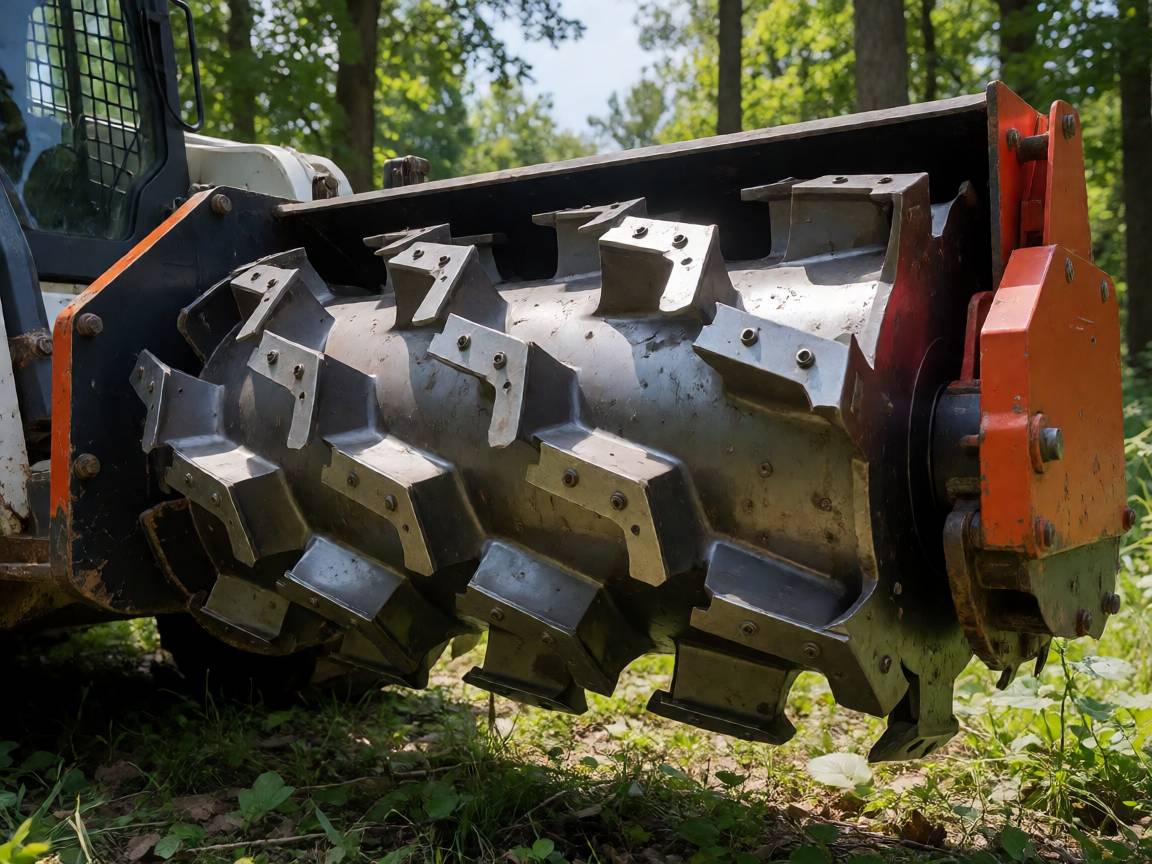
Both families mount their cutting tools with a single bolt and nut per station, which makes field replacement fast — one wrench, no press, no special puller. That design choice also means a lost bolt usually means a lost tooth, so hardware checks belong in every daily walkaround.
Forged knives or carbide hammers: choose for your ground
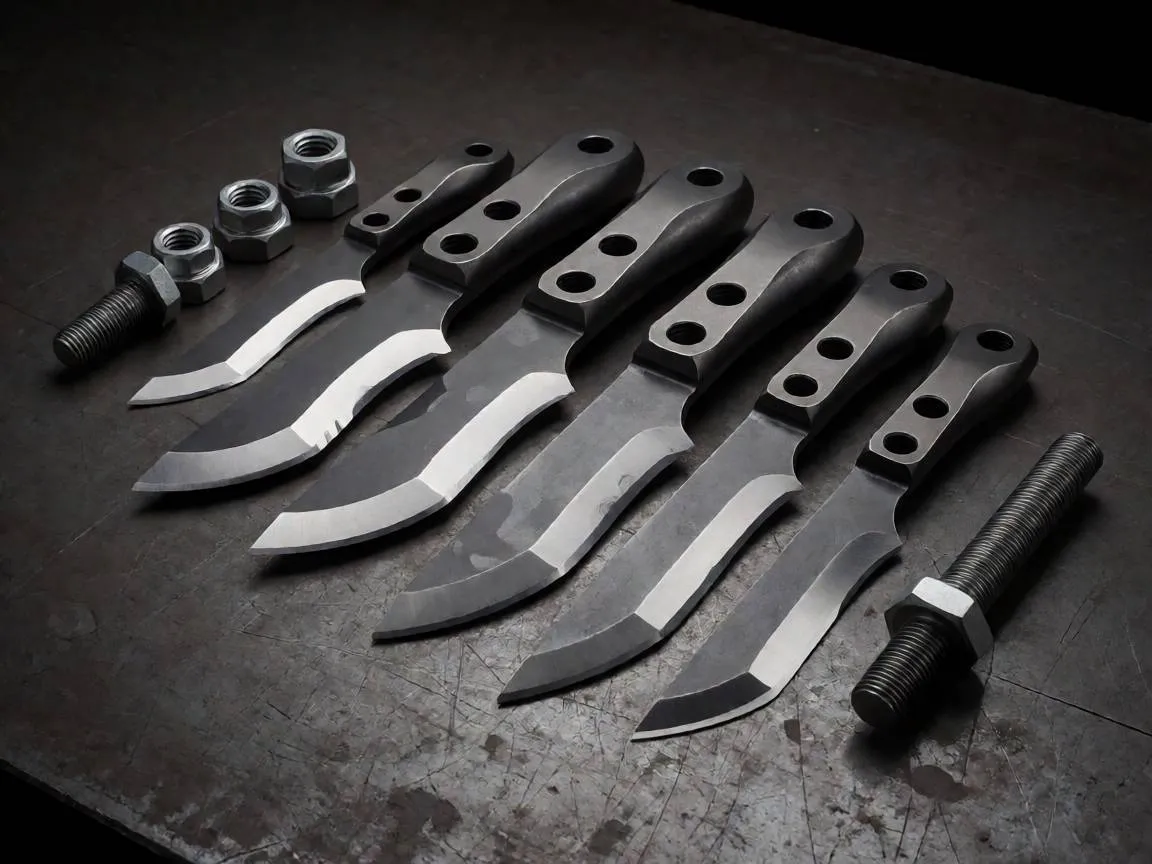
The classic Denis Cimaf cutting tool is the forged knife — the S1 through S5 series and equivalents like 10004, 10004HD, F0010-02, F0010-03 and XFM-DC159-PL. These are heat-treated forged steel blades that slice brush and small timber cleanly and can be resharpened several times on the machine. They are the right choice for organic ground: grass, brush, saplings, clean wood.
Rocky, abrasive ground is murder on forged edges. For that work the C1 and C2 carbide hammers (OEM references FC1046C and FC1049M) swap the sharp edge for a welded tungsten carbide head that shrugs off stone and soil contact. The cut is rougher and the tool is heavier, but the service life in rocky terrain is several times longer than any forged knife. Many contractors run mixed rotors — knives in the easy zones, carbide hammers at the edges where the head contacts soil.
Reading Denis Cimaf part numbers
OEM and aftermarket catalogs use a mix of number systems, which confuses a lot of buyers. The forged knives appear under S1–S5 style codes and longer references such as 806537RY (knife) or 10004HD (heavy-duty blade). The carbide hammers show up as FC1046C and FC1049M, also cross-listed as 806096RY. Holders are references like D132 405RY. Aftermarket makers, ourselves included, publish cross-reference tables that map these numbers to compatible replacements.
One honest caution: a matching number is not proof of fit. Check the mounting dimensions — bolt hole diameter, center distance and overall envelope — against your worn part before a big order. Five minutes with calipers beats a box of wrong teeth.
Replacement basics that save the rotor
Swapping teeth on a Denis Cimaf head is genuinely simple, but three habits make the difference between a five-minute job and a rotor repair. First, torque every bolt to spec and use new hardware where the old nut has lost its locking action. Second, replace or sharpen teeth in a balanced pattern — running a rotor with two heavy carbide hammers on one side and worn knives on the other beats up the bearings. Third, inspect the knife holders while the teeth are off: a cracked holder will eat a new tooth in an hour.
What we supply for Denis Cimaf machines
Our Denis Cimaf mulcher teeth are aftermarket carbide-tipped teeth engineered to the dimensions of the fixed-tooth heads in the DAF and DAH families. Bodies are forged from 42CrMo alloy steel and vacuum heat treated, cutting tips are brazed tungsten carbide in YG8 for clean conditions and YG11C for abrasive, rocky ground, and every seating surface and bolt hole is CNC machined for direct fit. Send a photo of your worn tooth, the original part number or your head model and we confirm the geometry within 24 hours.
Not sure whether your head takes knives or carbide hammers? Send us the model number and a photo of the rotor, or read our companion guide to FAE mulcher teeth if you run mixed equipment — the selection logic is the same across brands.
Frequently asked questions
Will aftermarket Denis Cimaf teeth void my mulcher warranty?
Wear parts are consumables, and using quality aftermarket teeth does not void the attachment warranty in most markets. What voids warranties is poor installation — loose bolts, mismatched holders or out-of-balance rotors. Keep the hardware torqued and you will have no issues.
Can forged knives be resharpened?
Yes, and this is their biggest cost advantage. S-series knives can be resharpened several times before replacement, either on the machine or in the shop. Carbide hammers cannot be sharpened economically — when the carbide is worn, the tool is done.
How do I confirm a tooth fits my DAF-180E or DAH-125D?
Match three things: the OEM cross-reference number, the bolt hole diameter and spacing, and the overall blade envelope. If any of the three differs, do not force it. Send us the model nameplate photo and we confirm fit before you order.
What is the minimum order for Denis Cimaf pattern teeth?
We keep standard knife and hammer patterns in production, so small trial orders are fine. Most buyers start with one rotor set to verify fit, then move to batch orders at better pricing. Contact us for current lead times.
Questions about fit, pricing or custom profiles? Contact our team — send your machine model and we will point you to the right teeth.
Related posts

Bandit Beast Wear Parts: A Practical Guide to Teeth, Cutterbodies and Rakers
A grinding contractor in Ohio added a second shift on his 3680XP to keep up with tear-off shingles, and his wear-parts bill doubled in a month. The teeth were not wearing out faster — he was simply ru...

Denis Cimaf Mulcher Teeth: A Replacement Guide for DAH and DAF Series
A land-clearing crew near Trois-Rivières was three days into a right-of-way job when the DAF-180E started leaving streaks of uncut brush. The operator pulled the head, and half the forged knives were ...

Chocky Bars: What They Are, Where to Use Them, and How to Choose
A quarry manager in Western Australia once told us his bucket rebuild budget was the only line item he could not predict. The lip would look fine at the monthly inspection, then lose six millimeters o...

FAE Mulcher Teeth: A Replacement Guide for UML, UMM and UMH Mulchers
FAE mulching heads hold their value better than almost anything else in the land clearing business, and for good reason. The weak point is not the machine. It is a row of steel teeth spinning against ...

Stump Grinder Teeth: When to Replace Them and How to Choose
Last month a tree service crew from Georgia sent us photos of their grinder. The machine had less than 800 hours on it, but the wheel was shaking so hard the operator refused to run it. They suspected...