
Searches for “AHWI mulcher knife” and “Prinoth mulcher knife” outnumber searches for “Prinoth mulcher teeth” in most parts lists — because on a lot of AHWI and Prinoth heads the cutting element really is a knife, not a tooth. The confusion costs money: a knife bolted into a hammer position, or the reverse, either will not seat or will not cut.
This guide separates the two, maps them onto the AHWI/Prinoth rotor families, shows how to confirm which one your rotor takes, and explains how a knife wears differently from a carbide tooth. For the tooth side of the same heads, see our Prinoth mulcher teeth guide; for the material and carbide basics, the forestry mulcher teeth guide.
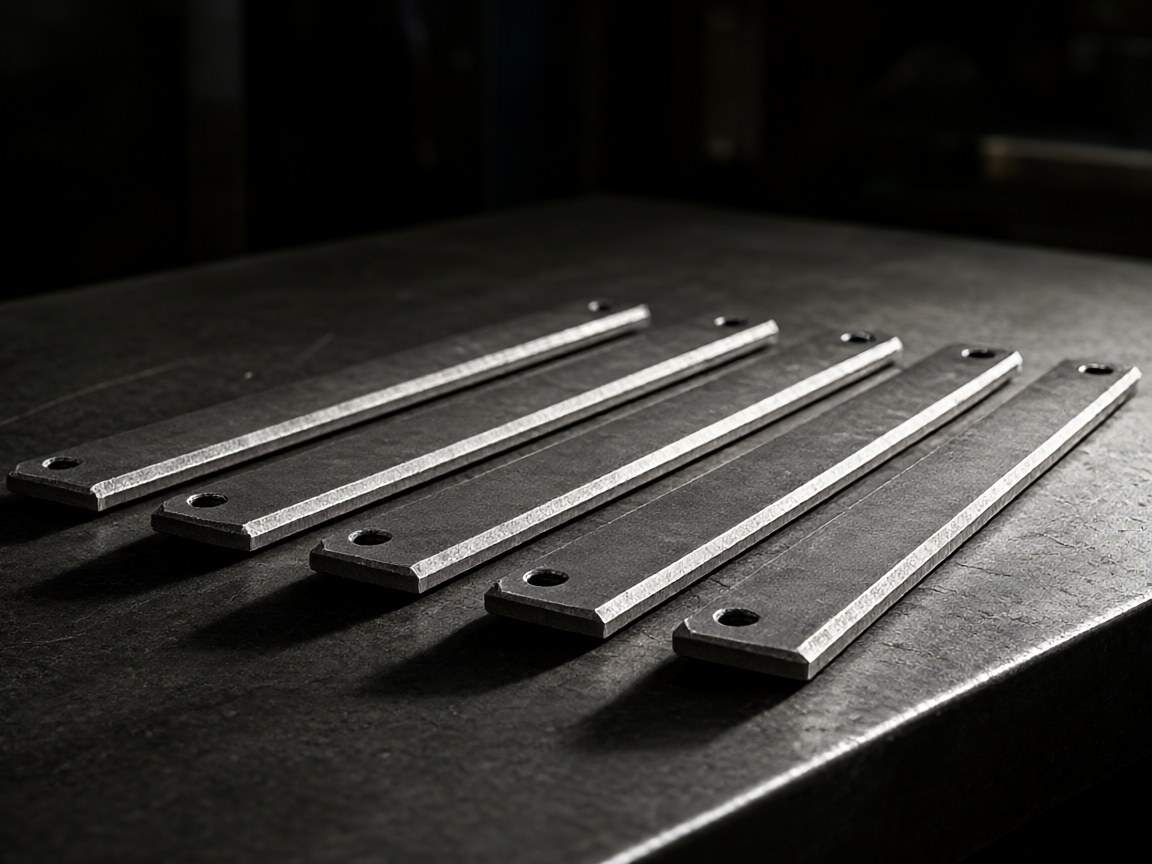
Knife or hammer: what the words mean on an AHWI rotor
Aftermarket listings use “knife”, “blade”, “hammer” and “tooth” almost interchangeably, which is where most ordering mistakes start. On AHWI and Prinoth vegetation management heads the distinction is mechanical:
- Knife / planer blade — a flat or slightly angled steel blade with one or two cutting edges, mounted in a slot or against a backing plate. It slices green material rather than pounding it. Reversible designs are flipped once and then replaced.
- Hammer / carbide tooth — a chunky body with a brazed tungsten carbide insert, retained by a bolt or stud. It is designed for impact and abrasion, not for a clean slice.
- Why it matters — the holder geometry is different. A knife needs a flat seat and edge clearance; a hammer needs a pocket that resists rotation under impact. They are not interchangeable even when the bolt lines up.
The AHWI / Prinoth rotor families and what they carry
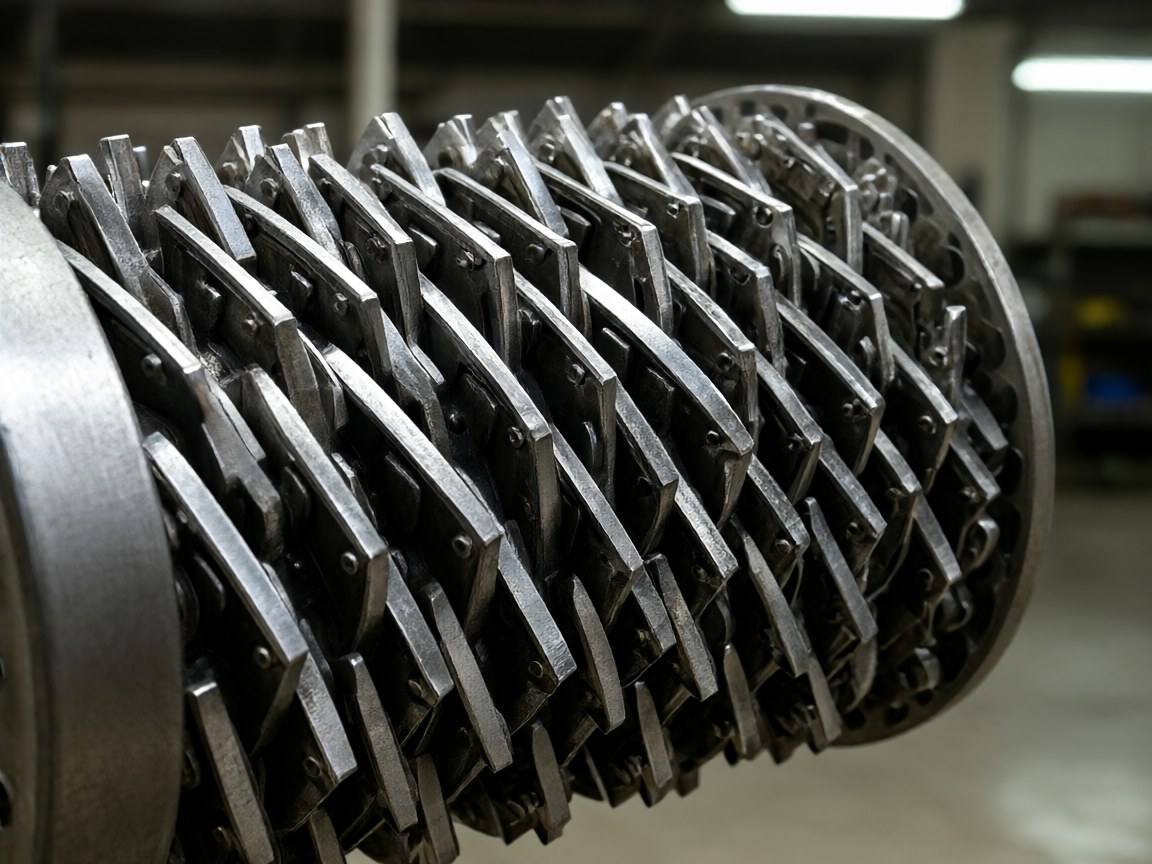
Three families dominate the aftermarket demand, and each has its own wear pattern:
UPT series
The UPT rotors are the classic AHWI mulching heads, and the UPT part numbering separates standard from heavy duty. UPT02 is the heavy reversible pattern, UPT09 the standard reversible pattern — both are bolted cutting elements that can be turned to a second edge before replacement. Because they are reversible, the wear story is about edge condition, not about carbide loss.
M-Class heads (M450 – M900)
The M-Class range scales the same idea across working widths. Teeth count per rotor changes with width — roughly twenty cutting elements on the narrow M450 through to seventy-plus on the widest turbo-configured heads — so a set for one machine is rarely a set for another. Order by head model and width, never by “M-Class” alone.
Raptor and specialised heads
The larger and more specialised rotors run heavier bodies and, on abrasive jobs, carbide elements in place of plain steel knives. These are the heads where a knife that is right for green material will be destroyed by rock contact within days.
How to confirm which element your rotor takes
- Look at the holder, not the blade. A flat slot with a backing face takes a knife; a pocket with a raised seat and a retaining bolt takes a hammer.
- Measure the element: overall length, width, thickness, and the distance from the mounting hole to the cutting edge.
- Note the fixing: single bolt, double bolt, or stud with a nut. Record the thread size and pitch.
- Check for a reversible design — if the blade has two usable edges, flipping it is part of normal maintenance and the replacement interval doubles.
- Photograph the holder with the element removed, plus the element itself beside a ruler.
How a knife wears (and why it is different)
A carbide tooth fails when the insert flattens or chips. A steel knife fails earlier and more gradually, and the symptoms show up in productivity before they show up on the part:
- Stage 1 — edge rounding. The blade polishes wood instead of cutting. Grinding takes longer, the operator pushes harder, fuel per acre climbs.
- Stage 2 — edge nicking. Stone or metal contact takes chips out of the edge. Each nick leaves a high spot that hammers the material instead of slicing it.
- Stage 3 — body wear. The blade thins and the mounting hole elongates. At this point the holder starts to wear, which is the expensive part.
A reversible knife gets one flip: use the second edge, then replace. Grinding a hardened planer blade without controlling heat draws the temper and the edge will be gone in hours. Torque and seating procedure is identical to any mulcher element and is covered in the mulcher teeth installation and torque guide.
Matching a replacement to an AHWI or Prinoth head
BauRong makes aftermarket elements for the AHWI and Prinoth rotors covered above, hot-forged from alloy steel and vacuum heat treated so the hardness profile is consistent through the body rather than only at the surface. The current selection sits on the AHWI/Prinoth mulcher teeth range, including BR-FM2009 for AHWI/Prinoth heads and BR-FM2026 for the wider M-Class rotors.
AHWI and Prinoth are trademarks of their owners; BauRong parts are independent aftermarket replacements identified by compatibility. Send the head model, the working width, the element measurements and a photo of the holder — contact us and we will confirm the match within 24 hours.
Related guides
- Prinoth mulcher teeth guide
- mulcher teeth installation and torque guide
- forestry mulcher teeth guide
- AHWI/Prinoth mulcher teeth range
- forestry mulcher wear parts range
Frequently asked questions
Is an AHWI mulcher knife the same as a mulcher tooth?
No. A knife is a flat or angled steel blade with one or two cutting edges that slices green material; a tooth or hammer carries a brazed tungsten carbide insert and is built for impact and abrasion. The holder geometry differs, so they are not interchangeable even when a bolt appears to line up.
How many knives are on a Prinoth M-Class rotor?
It scales with working width and rotor configuration — roughly twenty cutting elements on the narrow M450 up to more than seventy on the widest turbo heads. Order by head model and width rather than by the M-Class family name alone.
Can mulcher knives be sharpened?
A reversible knife is designed to be flipped once and replaced, not ground repeatedly. Grinding hardened planer blades without heat control draws the temper and the edge fails within hours. If the blade has no second edge left, replace it.
Why do my mulcher knives wear out on one side only?
Uneven wear almost always means the rotor is running with a mixture of new and worn elements, so the sharp ones take the load. Replace in sets and rotate positions at each service interval rather than replacing single blades as they fail.
Related posts

AHWI and Prinoth Mulcher Knives: Types, Fit and Wear
AHWI and Prinoth mulcher knives explained: knife versus carbide hammer, the UPT and M-Class rotor families, how to identify the blade on your rotor, and how wear actually progresses on a knife edge.

Vermeer Stump Grinder Teeth: Wheel and Vertical Grinder Fit
Vermeer stump grinder teeth by machine layout: wheel versus vertical grinders, the tooth styles each one takes, how to read wear, and how to match a replacement by dimension instead of by part number alone.

Bobcat Mulcher Teeth: Drum and Disc Fit, Wear and Replacement
Bobcat mulcher teeth differ between drum and disc heads. What the OEM part numbers map to, how the BR-FM2034 replacement fits, the two 1/2 inch UNF threads that decide it, and when a tooth is finished.

Haybuster and Duratech Grinder Teeth: A Fit and Wear Guide
Tub grinder teeth for Haybuster and Duratech machines: how tub and horizontal grinders load their hammers differently, the severe duty replacement that fits both, wear signs, and how to match a tooth by dimension.

Denis Cimaf DCC-301 and DCH-303: Tooth, Holder and Fitment Reference
How to read the Denis Cimaf part numbering for mulcher teeth and holders, what DCC-301 and DCH-303 actually are, how to check wear on the tooth and the holder, and how to order the right replacement by dimension.